Linklicious Review 2026: Crawling vs Indexing
Linklicious is one of the oldest names in this market. It launched in 2012 and it is still trading in 2026. That alone sets it apart, because most tools from that era are gone. So the interesting question is not whether Linklicious still works. It is what Linklicious actually does, and whether that matches what buyers think they are paying for.
This review answers that using the company's own published plans and FAQ, checked in August 2026. Two disclosures first. UltraIndexer competes with Linklicious, so the comparison section is clearly labelled and we state where they beat us. And Linklicious runs an affiliate programme paying recurring commissions that start at 25%. We are not in it, and there are no affiliate links here. That matters, because a paid commission shapes a lot of what gets written about this tool.
What Linklicious actually does
Read the Linklicious description of the mechanism and it is refreshingly clear. You submit the backlinks you have built. Linklicious then drips them out to three crawlers — Google, Majestic and Ahrefs — on a schedule you choose. It tracks whether a crawl happened. If no crawl comes, it pings again, daily, until one does.
That is a crawl service. Linklicious is a well-built one, and the logic behind it is sound. Their FAQ explains the problem it solves with a good example. Say you build 1,000 links. Most sit on brand new pages that Google has never seen. If Google never finds those pages, the links do nothing for you. Linklicious exists to make sure the crawler turns up.
Their own reading list makes the point even more plainly. Among the newsletters they link from the FAQ page, one is titled "Crawling vs Indexing." The company knows the difference. The question is whether the buyer does.
Linklicious pricing in 2026
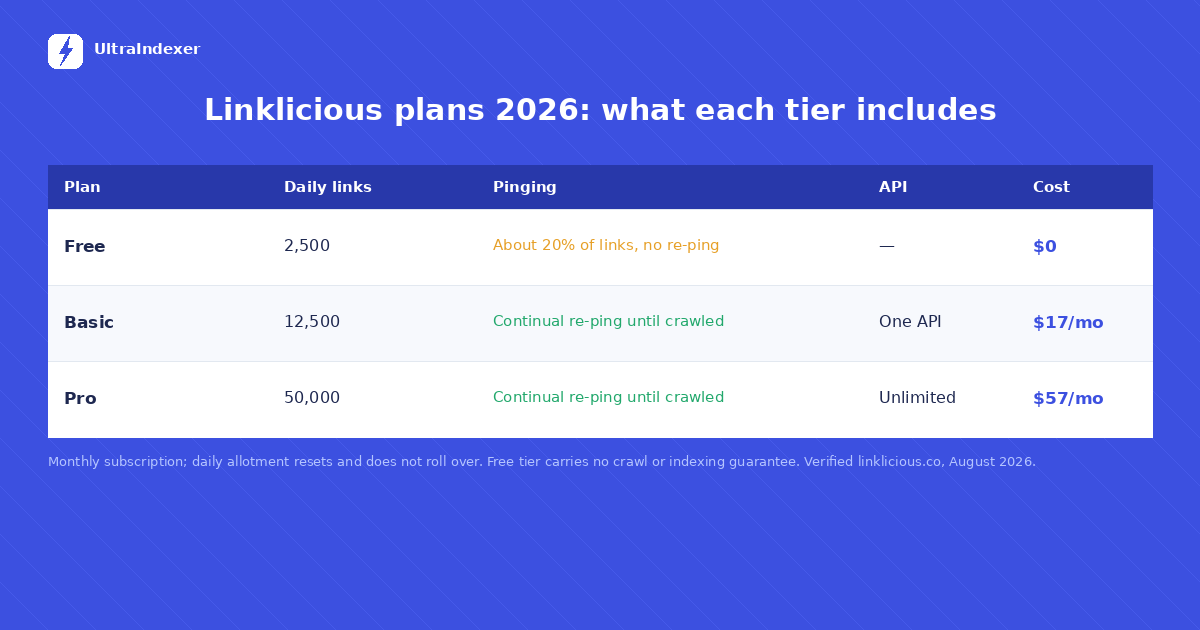
Linklicious sells three plans, and the pricing is modest. Free costs nothing. Basic is $17 a month. Pro is $57 a month. All figures verified from their published plans page in August 2026.
What separates them is volume and behaviour. The free plan allows 2,500 links a day. Basic allows 12,500. Pro allows 50,000. Those numbers are generous on paper, and at $57 a month for 50,000 daily submissions the headline cost per link looks tiny.
The free plan has a catch, and to their credit they publish it. Free accounts get their links placed alongside other free users' links, and only about 20% get pinged. There is no repeated pinging of links that stay uncrawled. Their FAQ says directly that free accounts do not get a guarantee of complete crawls or indexing. So the free tier is a sampler, not a working version of the product.
Paid plans add the parts that matter. Continual re-pinging until a crawl happens. Crawl statistics at the level of each link. API integration, limited to one API on Basic and unlimited on Pro. Paid users also get a monthly coupon for free links from a sister site, worth the same as their subscription.
One structural note. This is a monthly subscription. Stop paying and the service stops. There is also a housekeeping rule worth knowing: links are cleaned out every month or two, though on paid plans an uncrawled link is never deleted.
Crawling is not indexing, and the gap is the whole story
Here is the distinction that decides whether this tool solves your problem.
A crawl means Googlebot visited the page. Indexing means Google chose to store that page and show it in results. The first is a visit. The second is a decision. A page can be crawled every week for a year and never be indexed. Our guide to how link indexing works covers what happens between those two steps.
Linklicious is built around the first thing. The Linklicious feature set is pinging, crawl tracking, and re-pinging until a crawl lands. That is genuinely useful work. A link that is never crawled definitely cannot help you. Getting the crawler to arrive is a real step.
But it is a step, not the finish line. Most people buying an indexing service want to know one thing: is my backlink in Google's index right now? Crawl tracking cannot answer that. Only an index check can. Our guide to backlinks not getting indexed covers what happens between the crawl and the decision, and why so many crawled links never make it through.
What the indexing guarantee actually covers
Linklicious offers a money-back guarantee. It is worth reading closely, because the wording is specific and the test they prescribe is unusual.
The Linklicious promise is that the service will improve your indexing rate at Google, Majestic and Ahrefs, or you get your money back. And here is how they tell you to verify it. Note your backlink counts in Ahrefs Site Explorer, Majestic and Google. Build your links. Submit them. Check the counts again at one week and two weeks.
Two of the three checks in that method are tool databases, not Google's index. A backlink count going up in Ahrefs means AhrefsBot found your link. That is a fine thing to measure. It is just not the same as Google indexing it, and the two numbers routinely disagree. We wrote a full guide on exactly this problem: why backlink tools show different numbers explains why Ahrefs, Majestic, Moz and Google never agree, and which figure is worth acting on.
So the guarantee is honest on its own terms. Improve crawling and tool visibility, or refund. Just read it as what it says. It is not a promise that your links will appear in Google's index, and no service can make that promise anyway.
What Linklicious gets right
Longevity. Linklicious has run for fourteen years in a niche full of tools that vanish after two. That counts for something.
A clear mechanism. Their FAQ explains what the product does without hiding behind jargon. You can read the plans page and understand exactly what you are buying.
Real scheduling control. You set how fast links drip out, from a handful a day to a thousand. They default to a slow, safe rate. This is a genuine feature, and the thinking behind it is right. Our guide to drip feed backlinks covers why paced release beats dumping a batch.
Honest about the free tier. Plenty of tools bury the limits of a free plan. Linklicious states the 20% ping rate and the missing guarantee in plain text.
Low price. At $17 and $57 a month, the cost of trying it is small.
Where Linklicious falls short in 2026
No index verification. This is the big one. You get crawl data. You do not get a per-URL answer on Google index status. To find out what actually indexed, you need a separate bulk index checker anyway.
Success measured in the wrong database. The guarantee leans on Ahrefs and Majestic counts. Those tools have their own crawlers, their own gaps and their own delays. A rising Ahrefs count is not proof of a Google result.
Subscription, not credits. Link building is bursty. You build hard for three weeks then stop. A monthly fee bills you through the quiet months too, and your daily allotment does not roll over.
No published index-rate data. There are no test results on the site showing how many submitted links end up indexed, by link type. Without that, buyers are working from claims.
The affiliate effect. A programme paying 25% recurring commissions means many glowing reviews of this tool are written by people who earn money when you sign up. That is legal and common. It is also a reason to weight what you read, including this review, by who is being paid.
Linklicious vs UltraIndexer
Full disclosure: UltraIndexer is our product. Here is the fair comparison.
We agree on more than you might expect. Both services work on backlinks sitting on sites you do not own. Neither needs Search Console access. That distinction matters, because submitting URLs to Google yourself only works on properties you control. Both let you pace delivery rather than dumping everything at once.
The differences are real, and they follow from the crawl-versus-index split above.
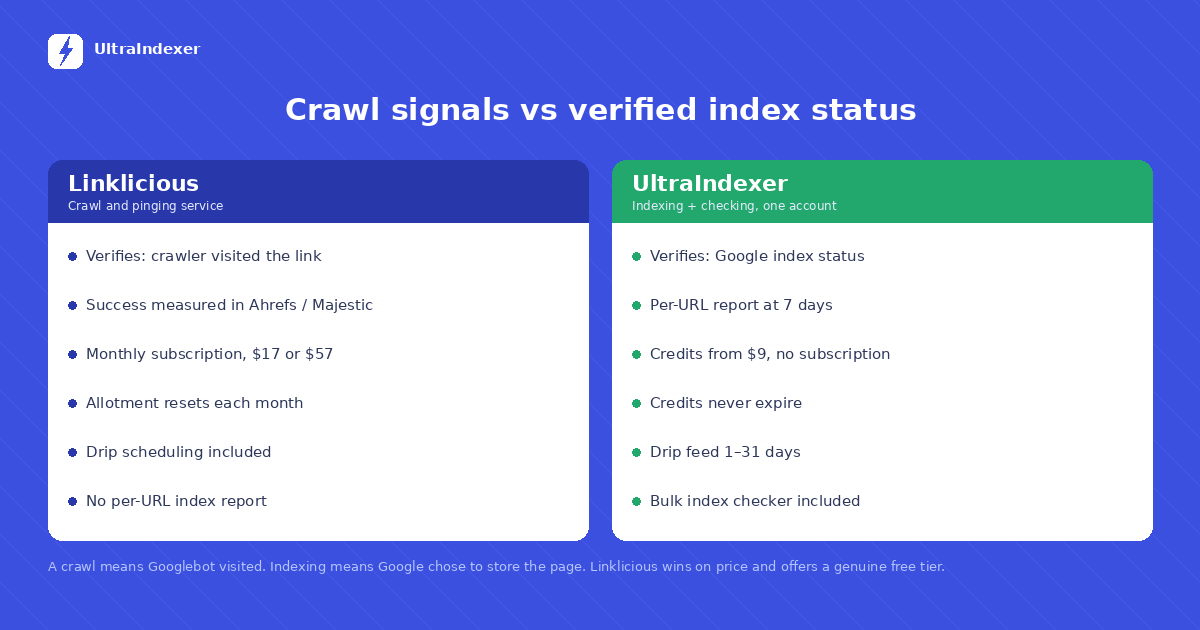
What gets verified. Linklicious verifies crawls, and measures success through Ahrefs and Majestic counts. UltraIndexer verifies Google index status and sends a per-URL report at seven days marked indexed or not indexed. One tells you the crawler came. The other tells you the outcome.
How you pay. Linklicious charges $17 or $57 every month, and the allotment resets. UltraIndexer sells credits from $9, with no subscription, and those credits never expire. If you index in bursts, credits fit better. If you submit heavy volume every single day of the month, their flat fee may work out cheaper — that is a fair point in their favour and worth doing the maths on. The premium end of the same market prices per URL instead — our IndexMeNow review covers what that actually buys.
Checking built in. UltraIndexer runs a bulk index checker in the same account, so you can check status before and after submitting. With Linklicious you would need a second tool for that step.
Where they beat us. They have a genuine free tier. Ours starts at $9. Their daily allotments at $57 are large. And they have been doing this since 2012, which is longer than we have.
The honest summary is that these are different products aimed at the same worry. If your problem is that Google has never visited your links, a crawl service addresses it. If your problem is that you cannot prove which links are indexed, you need index verification, and that is a different tool.
How we compared
This review is based on Linklicious's own published plans page and FAQ, both read in August 2026, plus their public statements about how the service works. We have no affiliate relationship with Linklicious and there are no affiliate links in this review. We did not run a paid indexing test, so we make no claim about their success rate in either direction — where they state a figure, we attribute it to them. Prices change, so check their site before buying. Where we compared them to our own product we said so plainly, and we listed the places they beat us. For a wider view of the field, see our backlink indexer comparison, and our Indexification review covers another long-running service in this space.
Frequently asked questions
Is Linklicious still working in 2026?
Yes. The service is live, the plans page is current, and the company has been trading since 2012. What it does has not changed much: it pings and tracks crawls rather than verifying Google's index.
How much does Linklicious cost?
There are three plans. Free, Basic at $17 a month, and Pro at $57 a month. Daily link allotments are 2,500, 12,500 and 50,000. It is a monthly subscription, not a credit purchase.
Is the free Linklicious plan worth using?
Only for a look around. Free accounts get about 20% of links pinged, share a listing with other free users, and get no repeated pinging of uncrawled links. Their own FAQ says free accounts carry no guarantee of complete crawls or indexing.
Does Linklicious guarantee indexing?
It offers a money-back guarantee that your indexing rate will improve at Google, Majestic and Ahrefs. The check they describe uses backlink counts in Ahrefs Site Explorer and Majestic. Those are tool databases, so a higher count is not the same as a confirmed Google index entry.
What is the difference between crawling and indexing?
Crawling is Googlebot visiting a page. Indexing is Google deciding to store that page and show it in search results. A link can be crawled many times and still never be indexed. Only an index check confirms the second step.
Does Linklicious tell me if my backlinks are indexed?
Not directly. It reports crawl activity for each link and tracks pings. To get a per-URL indexed or not indexed answer you need an index checking tool.
Does Linklicious have drip feed scheduling?
Yes. You choose the daily release rate, from around 10 links a day up to 1,000, and the default is deliberately slow. New submissions drip alongside earlier ones.
Verdict: a good crawl service, judged as one
Linklicious does what it says. It gets crawlers to your links, it keeps pinging until they arrive, and it lets you control the pace. It is cheap, it is clear about its free tier, and it has outlasted almost everything launched beside it. Judged as a crawl and pinging service, it holds up.
The mismatch is between that product and what most buyers are actually worried about. People search for indexing tools because they want proof their backlinks count. Crawl statistics and a rising Ahrefs number do not give them that proof. The guarantee, read carefully, does not promise it either.
So the choice comes down to which problem you have. If your links are never being found, a crawl service is a sensible fix, and Linklicious is a reasonable one. If you need to know which links are in Google's index, that is a different job.
UltraIndexer does both in one account: indexing with a verified per-URL report at seven days, plus a bulk index checker so you can prove the result yourself. See the packages — from $9, no subscription, and credits that never expire.