Why Your Backlink Tools Don't Agree (2026)
Run the same domain through Ahrefs, Moz, and Semrush on the same afternoon, and you will get three different backlink counts — often wildly different, sometimes off by thousands of links. Then check Google, and you will find a fourth number that matches none of the other three. This is not a bug in any of the tools. It is the predictable result of how each one is built, and once you understand the reasons, the disagreement stops being alarming and starts being useful.
This guide explains why backlink tools never agree with each other, why none of them agrees with Google, and how to read the gaps instead of trusting any single number. It is the parent guide to two more specific ones: if your problem is a link missing from one particular tool, jump to backlinks not showing in Ahrefs, and if your real concern is whether a link is in Google at all, read backlinks not getting indexed.
Every tool has its own crawler and its own index
The single fact that explains all the disagreement is this: each backlink tool runs its own web crawler and builds its own private database. Ahrefs has AhrefsBot. Semrush has its own bot. Moz has DotBot and its Link Explorer index. None of them shares data with the others, and none of them shares data with Google.
So when a tool reports your backlinks, it is not reporting "the backlinks that exist." It is reporting "the backlinks this particular crawler has found, on the pages it has visited, that its rules decided to keep." Change the crawler and you change the answer. That is the whole story in one sentence — everything below is detail.
Why the numbers differ, tool by tool
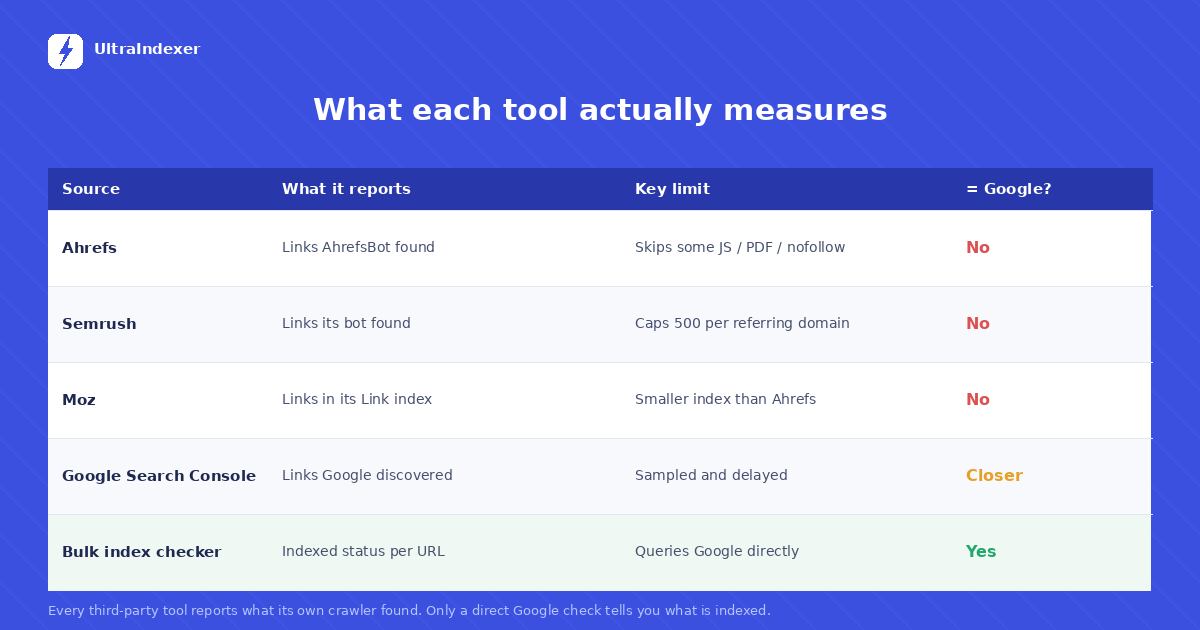
Each tool makes different trade-offs, and each publishes at least some of them.
Crawl frequency and budget. No crawler visits the whole web at once. Each one prioritises: high-authority pages get crawled often, obscure pages rarely, and some never. A backlink on a low-traffic page can sit undiscovered for weeks by one tool while another has already found it. This alone produces large gaps on any fresh link.
Per-domain caps. Semrush documents that its Backlink Audit pulls up to 500 backlinks per referring domain. If a single domain links to you 2,000 times, 1,500 of those links simply will not appear in that report. Other tools set different ceilings. These caps exist for performance reasons and are rarely mentioned in the interface.
How each tool treats JavaScript and nofollow. Links injected by JavaScript are expensive to render, so crawlers often skip them on pages that are not popular enough to justify the cost. Ahrefs documents that links from platforms like LinkedIn, Slideshare, and Quora, and links inside PDFs, frequently do not appear for exactly this reason. Different tools draw that line in different places.
Lost-link rules. When a crawler revisits a page and cannot confirm a link — because the site blocked the bot, returned an error, moved to a new URL, or changed a canonical — it may mark the link "lost" even though a human still sees it on the page. Each tool has its own definition of lost, so the same link can be live in one and lost in another.
Historical retention. Tools keep lost links in their reports for different windows. Semrush notes that its Backlink Analytics can look back further than its Backlink Audit, which is why two reports inside the same product can disagree about the same domain.
Why none of them matches Google
Here is the part that matters most, and the part most people miss. Even if a tool showed you every backlink perfectly, that number still would not match Google — because these tools measure a completely different thing.
A backlink tool tells you: this link exists on the web, and our crawler found it. Google's index tells you: this page is stored in Google's index and can pass signals. Those are different events. A link can exist, be found by Ahrefs, and still not be in Google's index at all — which means it passes nothing, no matter how confidently a tool displays it.
This is why "my link shows in Ahrefs" is not the reassurance it feels like. Ahrefs finding a link tells you AhrefsBot did its job. It tells you nothing about whether Google has indexed the page the link sits on. The only way to know that is to check Google directly, which our guide to backlinks not getting indexed covers in full.
How big are the gaps, really?
It helps to have a rough sense of scale, because the gaps are bigger than most people expect. On a mature domain, two major tools often differ by a wide margin on total backlinks. Referring-domain counts differ by less, but still enough to notice. The gap is widest on fresh links, where crawl timing rules everything, and it narrows over time as each crawler eventually catches up to the well-linked pages.
Three patterns are worth knowing. First, new links show up unevenly. A link published today may appear in one tool within days and take weeks in another, purely because of crawl schedules. Second, links on big platforms are the most likely to be missing everywhere, because JavaScript and nofollow handling hit social sites, forums, and document hosts hardest. Third, internal links are counted differently again, which is why internal-link totals rarely match across tools either.
So do not try to memorise numbers, which change constantly. Expect the shape instead: big gaps on new and platform links, small gaps on old and authoritative ones. When you see that pattern, the tools are working normally.
Does the disagreement actually matter for SEO?
For most decisions, no — and that is reassuring. If you are judging the overall strength of a link profile, or comparing two competitors, the relative picture is consistent enough to trust even when the raw numbers differ. A domain that looks strong in Ahrefs generally looks strong in Semrush too.
The disagreement only becomes a real problem in one case: when you need to know the fate of a specific link. Did the guest post you paid for actually get indexed? Is that tier-2 link passing anything? Here a tool's "found" status is not enough, because found is not the same as indexed. This is exactly when you stop trusting third-party counts and go straight to Google. It is also when an indexing workflow matters — our guide to getting backlinks indexed covers what to do when the links you care about are not in Google yet.
How to read the gaps instead of fighting them
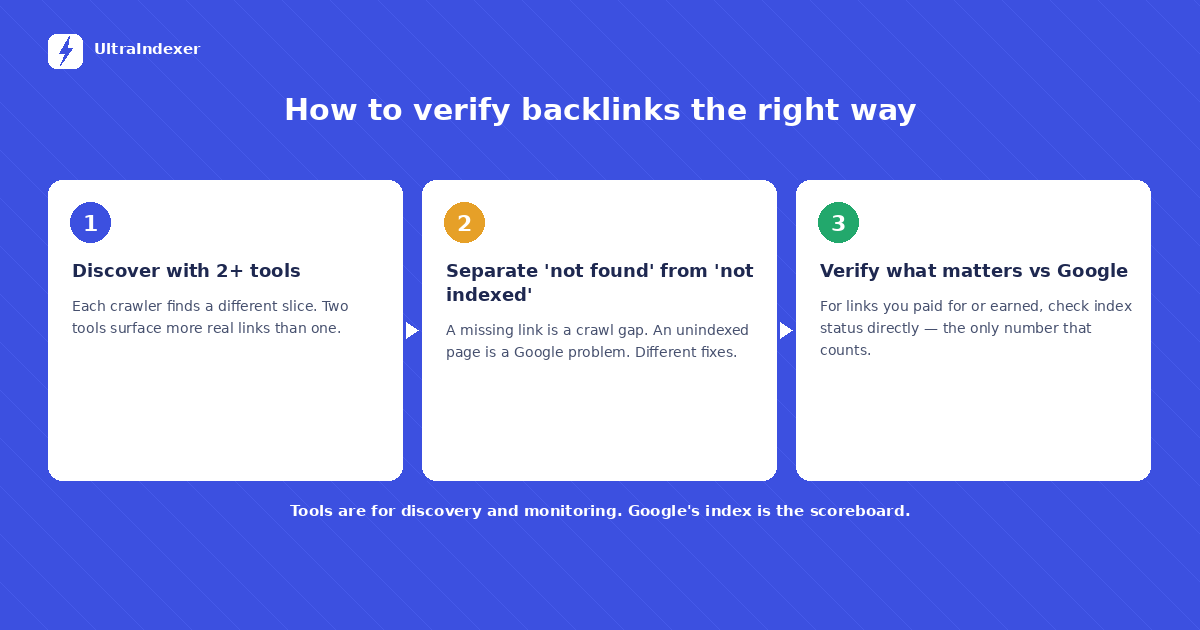
Once you accept that no single number is "the truth," the tools become more useful, not less. Here is how to work with them.
Use more than one discovery tool. Because each crawler finds a different slice, running two tools finds more real links than trusting either alone. If a link appears in even one reputable tool, it almost certainly exists — the tool that missed it just has not crawled that page yet.
Treat "lost" as "verify," not "gone." Before you act on a lost-link report, open the page. If the link is still there, the tool's crawler had a bad visit — not a real loss. The specifics for one tool are in our guide to backlinks not showing in Ahrefs.
Separate "not found" from "not indexed." These are two different problems with two different fixes. If a tool has not found a link, that is a crawl-coverage issue and usually resolves itself with time. If Google has not indexed the page, that is an indexing problem, and no amount of tool-checking changes it. Knowing which one you have saves a lot of wasted effort.
Verify what matters against Google. For links you actually care about — the ones you paid for or worked to earn — do not stop at a third-party tool. Check whether Google has the page indexed, because that is the only check that reflects whether the link can help you.
The one number that actually matters
All of this points to a single conclusion. The backlink counts in Ahrefs, Moz, and Semrush are estimates of what each crawler has found. They are useful for discovery and comparison, but they are not the scoreboard. The scoreboard is Google's index: a link only helps you if the page hosting it is indexed by Google, and no third-party tool measures that directly.
So the practical habit is simple. Use the tools to discover and monitor links, expect their numbers to disagree, and when a link genuinely matters, verify it against Google itself. UltraIndexer's bulk index checker checks up to 5,000 URLs against Google's index in one run and returns an indexed or not-indexed verdict per URL — the number the other tools cannot give you. For links that come back not indexed, the indexing service works to get them crawled, with per-URL reporting at both stages.
Frequently asked questions
Why do Ahrefs, Moz, and Semrush show different backlink counts?
Because each runs its own crawler and its own index, with different crawl budgets, different per-domain caps, and different rules for JavaScript, nofollow, and lost links. They are each reporting what their own bot found, not a shared truth, so the numbers rarely match.
Which backlink tool is the most accurate?
None is "accurate" in an absolute sense — each shows a different slice of the web. Ahrefs and Semrush generally have the largest indexes, but the most complete picture comes from using more than one tool for discovery and then verifying the links that matter against Google directly.
Why does Moz show fewer backlinks than Ahrefs?
Moz's link index is generally smaller than Ahrefs', so its crawler has found fewer links overall. That does not make Moz wrong — its Spam Score and domain metrics are useful — but for raw backlink discovery a smaller index simply surfaces fewer links.
Why doesn't my backlink count match Google Search Console?
Search Console reports links Google has discovered, which is a different dataset from any third-party crawler, and Google samples and delays its link reporting. None of the tools, including Search Console, is measuring exactly the same thing, so exact matches are not expected.
If a link shows in a backlink tool, is it indexed by Google?
No. A tool showing a link means that tool's crawler found it. Indexing is a separate question decided by Google, and a found link can still be unindexed — in which case it passes no signals. Verify index status against Google with a bulk index checker.
Do backlink tools show links faster than Google indexes them?
Often, yes. A tool's crawler can find and report a link before Google has indexed the page it sits on, which is why a link can show in Ahrefs while passing nothing in Google. The two processes run on separate schedules. This is the core reason to verify important links against Google rather than trusting a tool's discovery date.
Should I worry when a tool reports lost backlinks?
Not immediately. "Lost" often means the crawler had a blocked or failed visit, not that the link was removed. Open the page and check. If the link is still live, it is a crawler artefact; if it is genuinely gone, then it is a real loss worth investigating.
Stop chasing a single number
Your backlink tools will never agree, and that is fine — they were never measuring the same thing. Use them for what they are good at, discovery and monitoring, and let their disagreement remind you that none of them is the final word. The final word belongs to Google's index, and that is the one number worth verifying directly. Check what actually indexed with UltraIndexer's bulk index checker, and fix what isn't indexed from there. See packages — pay as you go, credits never expire.