Free Google Index Checkers: Where They Stop Working
Search for a free Google index checker and you get a full page of them. All promising bulk checks, all promising free. So we opened all eight and read what they actually allow.
The free limits run from five URLs to a thousand. One of them is not an index checker at all. One only works on websites you already own. And the one advertising a thousand URLs gives you two checks a month unless you subscribe.
Every figure below comes from the tools' own pages and pricing, read in August 2026. Disclosure: UltraIndexer sells index checking, so we are not neutral. We have named the tools that are genuinely useful and said where ours is not the answer.
What every one of these tools is actually doing
Worth knowing before you compare them. Almost all of these tools work the same way underneath: they run a site: query against Google for each URL and read whether a result comes back.
That matters because it means the accuracy differences between them are small. They are all asking Google the same question. What separates them is how many URLs they let you ask about, how often, what they charge, and whether you can do anything with the answer.
So compare a Google index checker on limits and terms, not on accuracy claims. The tool that returns the best answer is usually just the one that lets you ask the most questions.
The verified limits
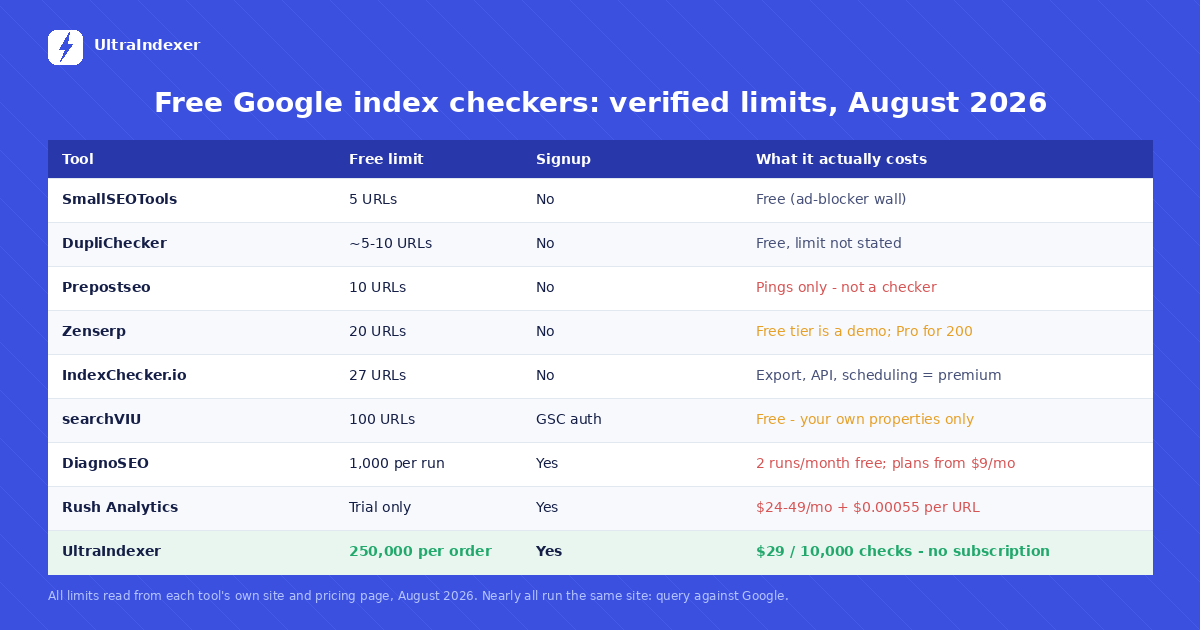
SmallSEOTools — 5 URLs. Their Google index checker states five web pages at a time. It also blocks you if you run an ad blocker.
DupliChecker — around 5 to 10. The page says it checks "more than five URLs at a time" without committing to a number.
Prepostseo — 10 URLs, and it is not a checker. This tool pings your URLs to Google and 65 other engines. Pinging asks a crawler to visit. It does not tell you whether anything got indexed. Useful tool, wrong list.
Zenserp — 20 URLs. Honest about what it is: their own page says the free version exists for demonstration purposes and asks you to register for the pro version, which allows 200.
IndexChecker.io — 27 URLs, no signup. The most generous no-account option. CSV export, scheduling, API and sitemap import are all premium.
searchVIU — 100 URLs, and the data is the best on this list. It uses Google's official Search Console Inspect API, so you get canonical URLs, last crawl date and real coverage status. See the catch below.
DiagnoSEO — 1,000 URLs per check, 2 checks a month. The tool page advertises the thousand. The pricing page prices the Bulk Index Checker at 3 credits per use, and plans start at $9 a month. Credits expire after a year, and you need an active paid plan before you are allowed to buy more.
Rush Analytics — not free. It ranks for free-tool searches and offers a 7-day trial. After that it is $24 to $49 a month plus $0.00055 per URL. The per-URL rate is genuinely low; the subscription is the price of entry.
What to look for in a Google index checker
Since accuracy is roughly equal across the board, these are the things worth comparing before you commit.
How many URLs per run. The single most important number, and the one buried furthest down most pages. A tool that handles 5 at a time is a different product from one that handles 500, even if both call themselves a bulk checker.
How often you can run it. A per-run limit means nothing without the monthly one beside it. DiagnoSEO is the clearest example: a thousand URLs per check sounds generous until you learn you get two checks.
Whether you can export. Results on a screen are not a record. If you check links for clients, you need a CSV with a timestamp against every URL, and most free tools do not give you one.
Whether the answer expires. Index status changes. A page indexed in March can be gone by June. A useful Google index checker lets you re-run the same list and compare, rather than starting fresh each time.
What the cost model is. A subscription bills you in quiet months. Credits that expire are a subscription wearing a different hat. Pay as you go means you spend when you have links to check and nothing when you do not.
Whether you can do anything with the result. Every Google index checker on this list ends at the diagnosis. Knowing 180 of your 500 links are missing is only useful if something happens next.
The catch nobody mentions: the most accurate tool cannot check backlinks
searchVIU is the best-built tool on this list. It queries Google directly rather than scraping search results, and it exports to CSV.
It also requires you to authenticate with Google Search Console and pick a verified property. That means it only works on websites you own.
Backlinks live on other people's websites. That is the entire point of them. So for the single most common reason people look for an index checker — did my backlinks get indexed — the most accurate tool on the page is unavailable by definition.
This is not a flaw in searchVIU. It is a boundary in Google's own API, which we cover in our guide to submitting URLs to Google. Google gives you precise data about your own properties and nothing about anyone else's.
What "free" turns out to mean
Line the eight up and three patterns appear in how a free Google index checker is packaged.
Free but tiny. SmallSEOTools, DupliChecker, Zenserp and IndexChecker.io genuinely cost nothing and genuinely cap out between 5 and 27 URLs. They are fine for spot checks. Nobody is auditing a campaign with them.
Free as a demo. Zenserp says so outright. Rush Analytics gives you a week. DiagnoSEO gives you two checks a month. The free tier exists to show you the paid one.
Free but scoped. searchVIU asks nothing and gives you Google's own data, on your own sites only.
None of that is dishonest. It is just worth reading the number on the pricing page rather than the one in the headline.
The arithmetic on a real backlink campaign
Say you built 500 backlinks last month and want to know how many landed.
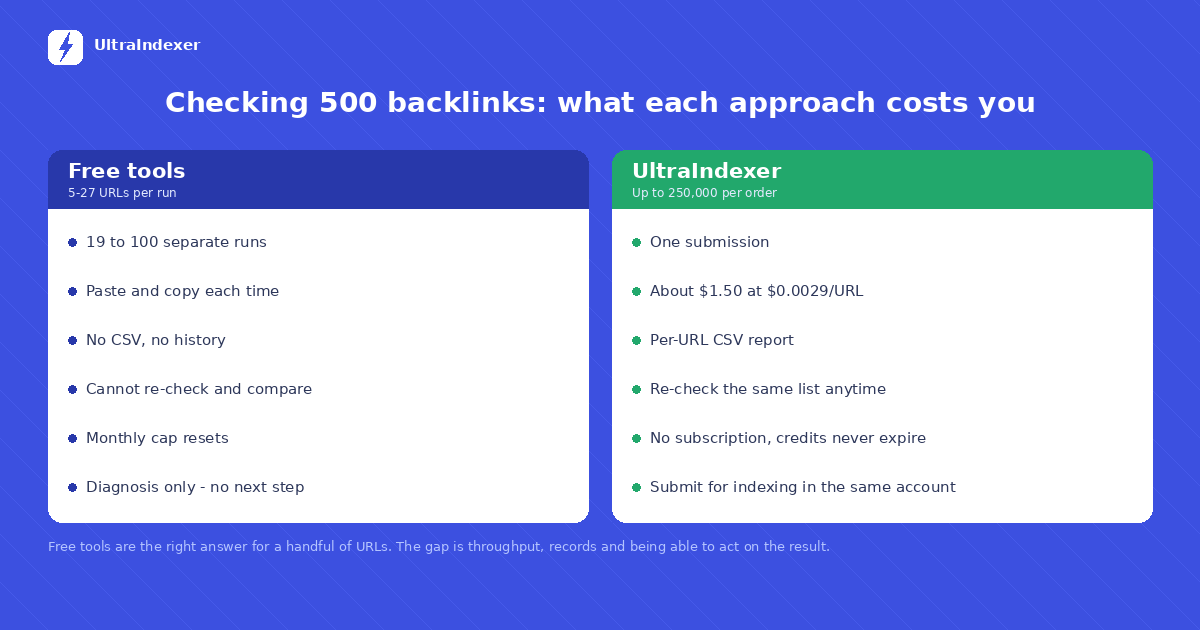
At 5 URLs a run that is 100 separate checks, pasting and copying each time. At 27 URLs it is 19 runs. At 20 URLs on Zenserp it is 25, and their free tier is a demo. searchVIU cannot do it because the links are not on your property. DiagnoSEO does it in one run and then you have one check left that month.
Now do it again in a fortnight to see what changed, because index status is not permanent. Then do it for the next campaign.
That is the wall. Not accuracy — every Google index checker here asks Google the same question — but throughput, repeatability and having a record afterwards.
Where UltraIndexer fits
Our product, so read it with that in mind.
Volume. Up to 250,000 checks per order against free caps of 5 to 27. One paste, one report.
Price. From $29 for 10,000 checks. That is $0.0029 per URL, and the 500-link campaign above costs about a dollar fifty.
No subscription. You buy checks when you need them. There is no monthly fee, no plan to keep active, and no requirement to already be subscribed before you can top up. DiagnoSEO requires an active plan before selling you credits; Rush Analytics requires a plan before you check anything.
Credits never expire. DiagnoSEO's expire after a year. Monthly allowances expire every month by definition. Link building comes in bursts, and a quota that resets on the first of the month suits the vendor, not you.
A report you keep. Every URL comes back marked indexed or not indexed with a timestamp, downloadable as CSV. That is a record you can hand a client, not a table that vanishes when you close the tab.
You can act on the answer. This is the real gap. Every tool here tells you which URLs are missing and then stops. In the same UltraIndexer account you can submit those URLs for indexing and re-check them afterwards. Our guide on what to do when backlinks are not indexed covers the workflow.
Where we are not the answer. Checking three URLs once. Use IndexChecker.io, pay nothing, close the tab. And if you only ever check pages on your own verified site, searchVIU gives you better data than any scraper including ours, free.
How we compared
Every limit, price and feature here was read directly from each tool's own website and pricing page in August 2026, not from third-party reviews. Where a tool's own pages disagreed with each other we said so — DiagnoSEO advertises 1,000 URLs per check on the tool page while the pricing page charges 3 credits per use on plans starting at $9 a month. We have no affiliate relationship with any tool listed and there are no affiliate links in this article. We did not run comparative accuracy tests, because these tools query Google with the same site: method and any difference would reflect the moment of the query rather than the tool. Prices change; check before you buy. UltraIndexer competes with several of these tools, which is disclosed above and in the section comparing them.
Frequently asked questions
What is the best free Google index checker?
It depends on the job. For a quick check with no account, IndexChecker.io is the most generous free Google index checker at 27 URLs and asks for nothing. If you only check pages on a website you own and have verified in Search Console, searchVIU gives you Google's own data for up to 100 URLs.
Is DiagnoSEO's index checker free?
Partly. The tool advertises up to 1,000 URLs per check, but the Bulk Index Checker costs 3 credits per use and paid plans start at $9 a month. The free allowance is 2 checks a month, credits expire after a year, and you need an active paid plan before you can buy more.
How many URLs can a free Google index checker handle?
Between 5 and 27 for the genuinely free ones. SmallSEOTools allows 5, Prepostseo 10, Zenserp 20 and IndexChecker.io 27. Higher limits come with a subscription, a trial clock or a monthly cap.
Can I check whether my backlinks are indexed with Google Search Console?
No. Search Console only reports on properties you have verified, and backlinks sit on domains you do not control. Tools built on the Search Console API inherit that limit.
Is a paid Google index checker more accurate than a free one?
Not meaningfully. Nearly all of them run the same site: query against Google. You pay for volume, speed, exports, history and the ability to re-check, not for a better answer.
How much does it cost to check 500 backlinks?
With free tools, nothing in money and roughly 19 to 100 separate runs in time. With UltraIndexer it is about $1.50, in one submission, with a per-URL CSV report at the end.
Why do index checkers disagree with Google Search Console?
They measure different things. Search Console reports Google's internal record for your property; scrapers report what a public search returns right now. Our guide on why backlink tools disagree explains why these numbers rarely line up.
The short version
Every free Google index checker here is fine, as long as you read the number on the pricing page instead of the one in the headline. Five to 27 URLs, no account, instant answer. For checking a handful of pages that is all anyone needs, and we would not pretend otherwise.
They stop being fine at scale. Nineteen runs to check one campaign, no history, no export, no way to act on what you find, and a fresh cap on the first of every month.
UltraIndexer checks up to 250,000 URLs per order from $29, with no subscription, credits that never expire, and a per-URL report you can download. And when the report shows links missing from Google's index, you can submit them for indexing from the same account instead of starting again somewhere else. See the checking packages.