Drip Feed Backlinks: Safe Link Velocity in 2026
Should you drip feed backlinks, or is the whole idea an SEO myth? The honest answer is: a bit of both. The scary version of "link velocity" that gets repeated in forums is not how Google describes its own systems. But pacing your links still makes practical sense — for reasons that have more to do with patterns, crawling, and risk than with any speed limit.
This guide covers the link building side of drip feed SEO: what link velocity actually means, what Google has said about it, what natural and unnatural growth looks like, and how to pace your builds. If your links already exist and your question is how to submit them, that is a separate decision — our guide to what drip feed indexing is covers it in depth.
What link velocity actually means
Link velocity is the rate at which new backlinks appear pointing to your site. Ten new links a month is a velocity. Three hundred in a week is a different one. The term describes a pattern over time, not any single link. When people say drip feed backlinks, they mean shaping that pattern on purpose.
Every site has a natural baseline. A local business site might earn a few links a quarter. A news site earns hundreds a day. Neither number is good or bad on its own. What matters is how a change compares to the site's own history, and to what sites like it normally attract. That comparison is the whole subject of this guide.
What Google actually says about link velocity
Here is where most articles on drip feed backlinks go wrong. Google has said in public that no "link velocity" metric exists in its ranking systems. A speed limit on link building is not how Google describes its own spam detection. What Google does act on is unnatural link patterns: links that look bought, exchanged, automated, or manipulative — at any speed.
So why pace links at all? Three practical reasons survive the myth-busting.
Pattern risk is real even if velocity is not. A burst of similar links from similar sources in a short window is easy to spot as a campaign. The same links spread over weeks are not. Speed does not make a link unnatural — it makes an unnatural pattern more visible.
Crawling and indexing behave better with pacing. Links on low-authority pages compete for scarce crawl attention. Spacing new links out gives each batch a better chance of being crawled and counted. It is the same logic our drip feed indexing product applies at the submission stage.
Budgets and quality control improve. A paced campaign lets you watch which link types actually get indexed and adjust before the budget is spent. A one-day blast gives you that lesson only after the money is gone.
Natural vs spiked: what the patterns look like
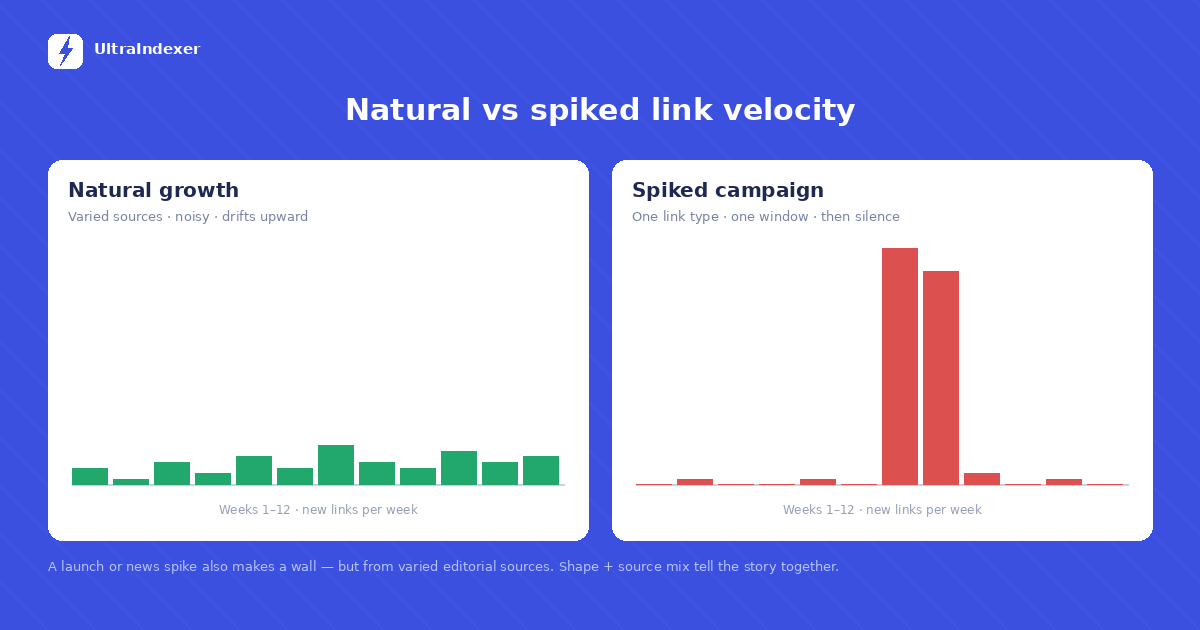
Picture two charts of new links per week over three months.
The natural profile drifts upward with noise: three links one week, one the next, a small bump when a post does well, back to baseline after. The sources vary — a blog mention, a directory, a forum thread, a news pickup. Anchors vary too, and most of them are branded or plain URLs.
The spiked profile is a flat line, then a wall: near zero for weeks, then dozens or hundreds of links inside a few days, mostly from the same class of site, often with matching anchor text. Then silence again. Nothing about any single link is necessarily bad. The shape is what tells the story.
One important exception: natural spikes exist. A product launch, a news story, or a viral post produces exactly this wall shape. Google handles those fine. The links come from many kinds of sites, chosen by real editors. The lesson is not "spikes are fatal." It is that a spike made of one link type, one anchor pattern, and one tier of sites does not look like a news event. It looks like an order being delivered.
How to set a safe building pace
To drip feed backlinks well, forget universal numbers. The baseline is your site's own history. Three factors set the range.
Site age and history. A new domain has no link history at all. Every pattern it produces is its first impression. Slower is safer in the first months. Add a few links a week, from varied sources, with mostly branded anchors. An established site with years of steady growth has far more room. Its baseline absorbs bigger additions without changing shape.
What sites like yours attract. A niche B2B service earning forty links a week would be remarkable. A consumer brand doing the same is unremarkable. Look at competitors' link growth in any backlink tool and let the category set your sense of normal.
Campaign mix. Links you earn — guest posts, mentions, press pickups — carry their own variety. Add them at the pace your outreach lands them. Volume link types — tier 2, web 2.0s, directories — are the ones that create recognisable walls. They benefit most from being dripped over weeks rather than dumped in days.
A workable default when you drip feed links for a modest campaign: spread each month's volume links across the whole month, not the first week. Keep editorial links flowing at their natural pace. Vary anchors. Let the occasional quiet week happen. Perfectly even output is itself a pattern — real profiles have gaps.
Two separate dials: building pace and submission pace
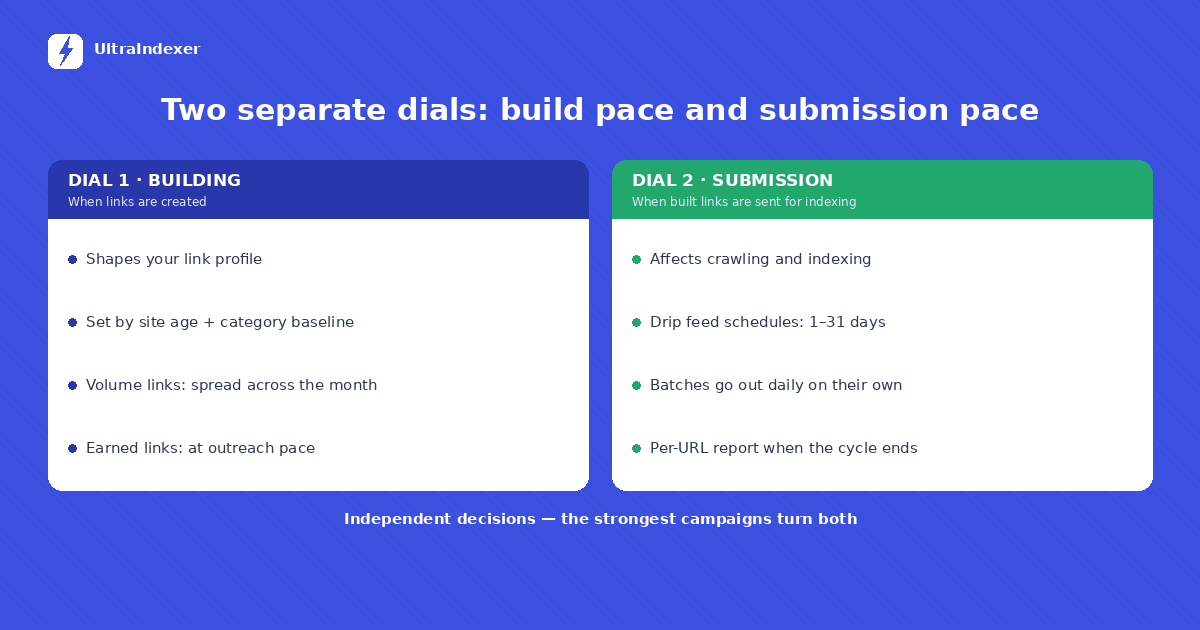
To drip feed backlinks is one choice. To drip feed the indexing of those links is another. They happen at two different stages — a split our drip feed indexing guide covers in full. You can build slowly and submit all at once. You can build fast and submit bit by bit. The dials move on their own.
In practice, the strongest setup turns both dials. Pace the building so the profile grows in a natural shape. Then pace the submissions so each batch gets proper crawl attention. With drip feed indexing schedules from 1 to 31 days, the second dial is a setting, not a spreadsheet. You choose the window and the batches go out daily on their own.
How to drip feed backlinks in practice: a month, mapped
Here is what it looks like to drip feed backlinks for one month: a campaign of 10 editorial links and 200 volume links supporting them.
Week one: the first two or three guest posts go live as outreach lands them. The first 50 volume links begin building on a spread — a dozen or so per weekday, sources rotated. Weeks two and three: the same rhythm continues. Anchors stay varied. One week runs lighter, and that is fine. Week four: the last editorial pieces land and volume building finishes. Then the whole batch goes to indexing on a 14–21 day drip schedule, so submissions stay paced even after building ends.
By the end of the cycle, the profile shows six weeks of varied, plausible growth instead of a two-day wall. Every link has been submitted at a rate the linking pages can absorb. Then check what indexed, resubmit what stalled, and carry the numbers into next month's plan.
Frequently asked questions
Is link velocity a Google ranking factor?
Not as a metric. Google has said there is no link velocity signal. What its systems target is unnatural link patterns, at any speed. Pacing helps because it keeps campaign links from forming an obvious shape — not because it stays under a speed limit.
How many backlinks per day is safe?
There is no universal safe number, and anyone quoting one is guessing. The honest guide is your site's own baseline and what sites in your category normally attract. New domains should stay conservative; established sites with steady link history have much more room.
Should I drip feed backlinks or build them all at once?
For volume link types, drip feed backlinks rather than building in a burst — pacing shapes your profile. Submission pacing is a separate decision that affects crawling. Doing both, building across the month and submitting on a multi-day drip schedule, gives the best combined result.
Do natural link spikes hurt SEO?
No. Launches, news coverage, and viral content create sudden link walls all the time, and Google handles them because the links come from varied, editorial sources. The risky shape is a spike made of one link type with matching anchors from similar sites.
What is the difference between drip feed backlinks and drip feed indexing?
To drip feed backlinks means pacing when links are built. Drip feed indexing means pacing when already-built links are submitted to an indexing service. They solve different problems. You can use either alone, or both together.
Pace the building. Pace the submissions.
The myth version of link velocity deserves to die — there is no speed camera. But the practical case to drip feed backlinks earns its place. Paced building keeps campaign links from forming a recognisable wall. Paced submission gives every link its best chance of being crawled and counted. UltraIndexer handles the second dial for you: submit your built links once, choose a drip feed schedule from 1 to 31 days, and get a per-URL indexed or not-indexed report when the cycle completes. See indexing packages — pay as you go, credits never expire.