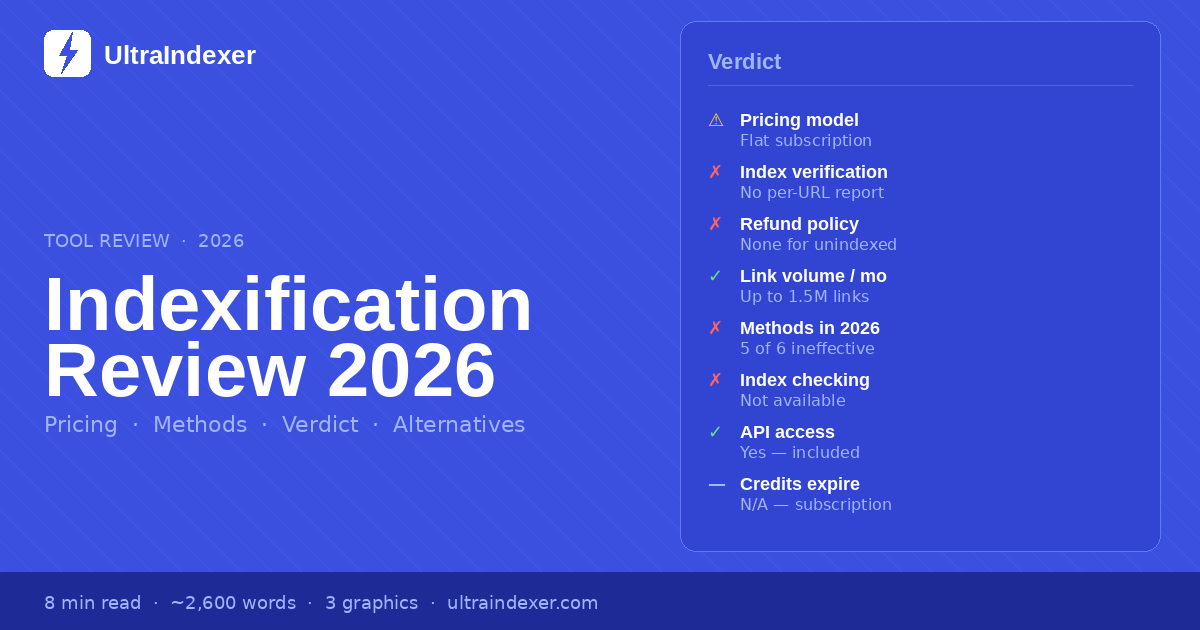
Indexification Review 2026: Is It Still Worth It?
Backlinks that aren't indexed by Google contribute nothing to your rankings. If you've ever spent money building links only to watch them disappear into the void, you already understand the problem. Link indexing is the step that determines whether your investment pays off — and Indexification has been trying to solve it since 2012.
This review covers what Indexification actually does, how its methods hold up in 2026, what it costs, and whether it's the right tool for the way you build links. No affiliate arrangement. No paid placement.
What is Indexification?
Indexification is a mass backlink indexing service that has been running since approximately 2012, making it one of the oldest tools in this category. It operates on a flat monthly subscription: $17.97 per month for access to a set of automated submission processes designed to get your backlinks crawled by search engine bots.
The submission limit on Indexification is 1.5 million links per month — 50,000 per day. That volume ceiling puts Indexification squarely in the territory of high-volume automated link building: GSA Search Engine Ranker users, PBN operators, and agencies running tier-2 and tier-3 campaigns at scale. That was the original audience in 2012, and it largely remains the audience today.
One thing Indexification does not do: verify whether submitted links were actually indexed in Google. It tracks crawler visits — bots visiting your URLs — but crawler visits and confirmed indexing are different events. Indexification measures the first. Whether Google then decides to add those URLs to its index is a separate decision the platform doesn't report on. That distinction becomes important when evaluating what you're actually paying for.
How Indexification works
Indexification submits URLs through a stack of automated crawl-signal techniques. Some of these are described openly in its marketing; others are referred to as "secret ingredients" — proprietary processes the platform doesn't detail publicly.
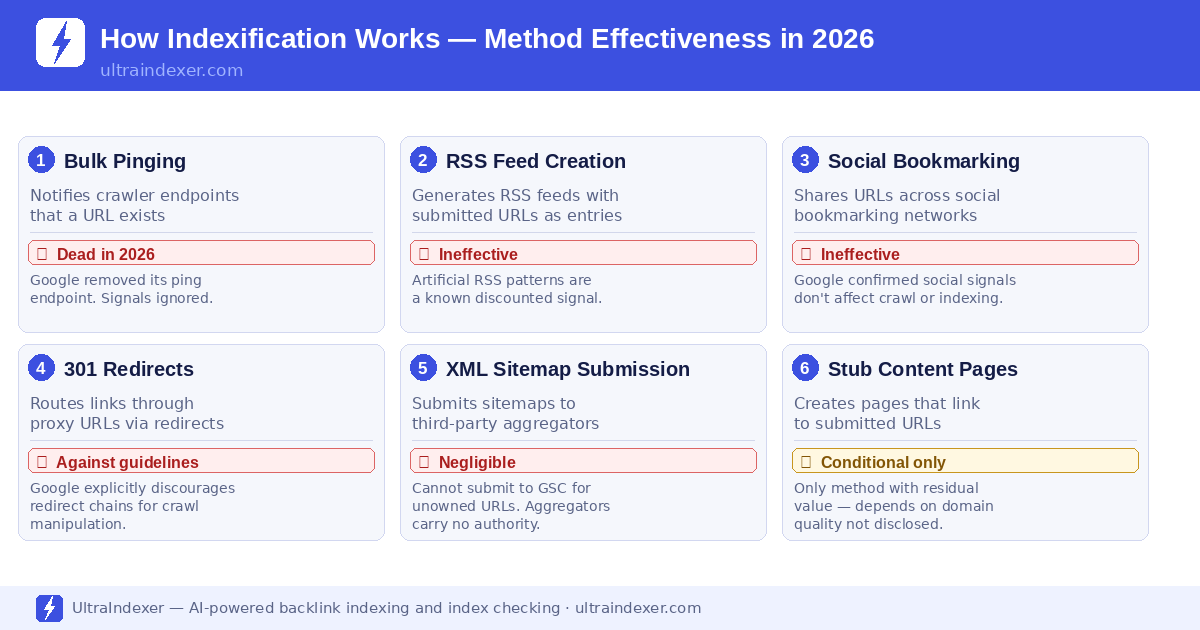
The documented methods are well-known in the SEO community. Here is an honest assessment of each one in 2026:
| Method | What it does | Verdict in 2026 |
|---|---|---|
| Bulk pinging | Sends simultaneous notifications to crawler endpoints signalling a URL exists | ❌ Dead — Google removed its ping endpoint. Signals are ignored. |
| RSS feed creation | Generates RSS feeds containing submitted URLs, then pings RSS aggregators | ❌ Ineffective — artificial RSS patterns stuffed with backlinks are a known and discounted signal. |
| Social bookmarking | Shares submitted URLs across social bookmarking networks | ❌ Ineffective — Google has confirmed social signals play no role in crawl priority or indexing. |
| 301 redirects | Shortens links and routes them through proxy URLs via redirect chains | ❌ Against guidelines — using redirect chains to manipulate crawler behaviour is explicitly discouraged by Google. Low-authority proxy hops dilute any signal further. |
| XML sitemap submission | Builds sitemaps of submitted URLs and pings third-party aggregators | ❌ Negligible — Google Search Console only accepts sitemaps for verified domain owners. Indexification cannot submit to GSC for URLs it doesn't own. Third-party aggregators carry no authority. |
| Stub content pages | Creates low-content pages that link back to submitted URLs | ⚠️ Conditional — the only method with any residual effectiveness. Depends entirely on whether Indexification's own hosting domains are indexed and actively crawled. The platform does not disclose the quality of this infrastructure. |
Five of the six documented methods are no longer effective. The sixth has conditional value that depends on infrastructure Indexification doesn't make transparent. What Indexification reliably delivers is crawler visits — bots will visit your submitted URLs. Whether Google then decides those URLs are worth indexing is a separate question these methods have diminishing influence over.
Indexification pricing
Indexification has a single plan: $17.97 per month, covering up to 1.5 million link submissions with a 50,000 per day cap. There is no pay-per-use option, no credits system, and no way to pause, scale down, or roll over unused capacity. You pay the same amount whether you submit 500 links or 1.5 million in a given month.
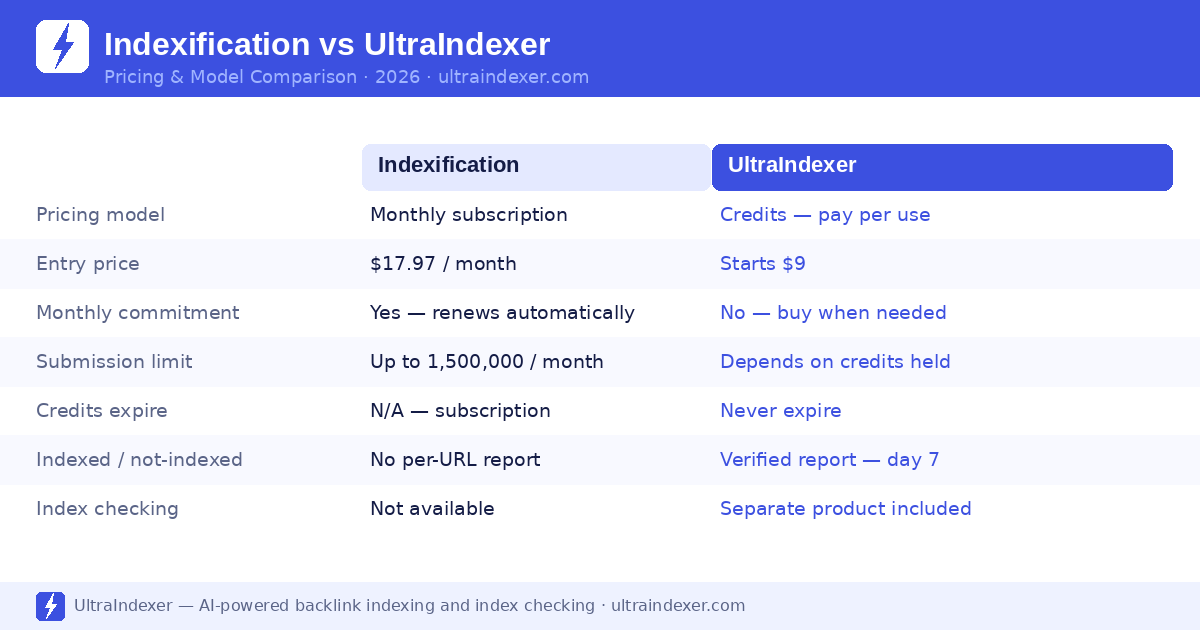
The per-link cost of Indexification only makes sense at full utilisation. If you are consistently submitting close to the monthly ceiling, the economics are hard to beat anywhere in the market. If your real monthly volume is 20,000–100,000 links — realistic for most agencies and freelancers — you are paying for capacity you will never reach.
Indexification does not advertise a refund policy for links that fail to index. Because Indexification pricing is not tied to individual link outcomes, there is no mechanism for one — you pay for access to the system, not for verified indexed results.
What Indexification does well
A fair Indexification review requires acknowledging what the platform genuinely delivers, not just where it falls short.
Volume at low cost
1.5 million submissions for $17.97 is the lowest per-link rate available in the category. For automated link builders running genuinely high volume, nothing else competes on price.
API access included
Full API access is part of the standard Indexification plan with no additional cost. It integrates with GSA Search Engine Ranker and similar tools, making submission automatic as links are built.
Drip-feed scheduling
Indexification allows links to be scheduled up to 30 days ahead, spreading submissions over time rather than sending everything at once. See our guide to drip feed indexing for when this matters.
Thirteen years of operation
Longevity means something in a category full of tools that appear and disappear. Indexification's infrastructure is reliable and the service is stable — it does what it says it will do at the submission level.
Where Indexification falls short in 2026
The limitations of Indexification are structural — not cosmetic issues that a UI update would fix. They are about whether the underlying approach still works the way Google operates today.
The methods are increasingly ineffective
Five of Indexification's six documented techniques are either dead or negligible in 2026. Bulk pinging, RSS feed generation, social bookmarking, redirect manipulation, and third-party sitemap submissions all worked reliably in 2013. Google has since learned to identify and discount all of them. The techniques that remain — particularly stub content pages — depend on the quality of infrastructure that Indexification doesn't disclose. Submitting millions of links through these channels creates the appearance of activity. It does not reliably produce indexed backlinks.
No per-URL indexed or not-indexed report
Indexification's reporting shows crawl tracking — whether bots visited your submitted URLs. It does not show which URLs were actually added to Google's index. Crawling and indexing are different events. A bot visiting a page and Google choosing to index it are not the same thing, and Indexification only confirms the first. Without a verified indexed or not-indexed result per URL, you have no data on what actually worked. You cannot report this to clients, and you cannot make informed decisions about which links to resubmit or abandon.
Subscription model creates waste at variable volume
Link building volume is rarely consistent month to month. Campaigns start and stop. Client work surges and quiets. With Indexification, you pay $17.97 whether you use 500 submissions or 1.5 million. There is no flexibility — no pause, no scale-down, no credits to carry forward. Every slow month is a full subscription cost for capacity you did not use. Prefer pay-per-result billing instead of a subscription? See our SpeedyIndex review.
Linkindexer.io takes a different approach again — one-time credits at a flat per-URL rate. See our Linkindexer.io review for the full breakdown. Another long-running option that bills monthly and reports crawls rather than index status is covered in our Linklicious review.
No index checking product
Submitting backlinks for indexing and checking whether existing backlinks are already indexed are two different workflows. Indexification covers only the first. If you want to audit an existing link profile and identify which links are currently in Google's index and which aren't, you need a separate tool entirely.
Who Indexification is — and isn't — for
Indexification has a specific user. That user is running automated link building at genuinely high volume — 500,000 or more links per month — using tools like GSA Search Engine Ranker, building tier-2 and tier-3 campaigns at scale where the cost per link is the primary concern and per-URL verification is not part of the workflow. For that user, Indexification's pricing model makes clear economic sense and the API integration removes manual overhead entirely.
Indexification is a poor fit for:
- ✗SEOs running curated link campaigns where each link has real cost and you need to know exactly which ones indexed
- ✗Agencies reporting to clients on indexed backlink counts — Indexification provides no per-URL verification to show
- ✗Anyone whose monthly submission volume varies significantly and who doesn't want to pay for unused capacity
- ✗Anyone who also needs to audit whether existing backlinks in their link profile are currently indexed in Google
The alternative: UltraIndexer
The core gap with Indexification — for SEOs who need verified results rather than crawl activity — is the absence of a per-URL indexed or not-indexed report. UltraIndexer is built around that verification step.
Links submitted through UltraIndexer's indexing service are processed through a dual-phase engine and return a verified indexed or not-indexed status per URL at day 7. You know exactly which links indexed and which didn't. There's no guesswork about what the service delivered.
| Indexification | UltraIndexer | |
|---|---|---|
| Pricing model | Monthly subscription | Credits — pay per use |
| Monthly commitment | Yes — fixed cost every month | No — buy when you need |
| Credits expire | N/A — subscription model | Never |
| Verified indexed / not-indexed per URL | No | Yes — day 7 report |
| Index checking product | Not available | Yes — same account |
UltraIndexer also includes index checking as a separate product on the same account. If you want to audit your existing link profile — identifying which backlinks are currently in Google's index and which aren't — that's available without switching tools. The per-link cost is higher than Indexification's theoretical rate at maximum utilisation. The difference is that you're paying for a verified outcome, not a stack of crawl signals.
Frequently asked questions
Indexification is a mass backlink indexing service operating on a monthly subscription of $17.97, covering up to 1.5 million link submissions per month. It uses a set of automated crawl-signal techniques — pinging, RSS feeds, social bookmarking, redirect chains, sitemap aggregation, and stub content pages — to attempt to get submitted backlinks crawled by search engine bots. Indexification has been operating since approximately 2012.
For a narrow use case — automated link builders running 500,000 or more submissions per month where price per link is the primary concern — Indexification still makes economic sense. For most other SEOs, the picture is less clear. Five of its six documented methods are no longer effective, it provides no per-URL indexed or not-indexed verification, and the flat subscription creates waste for anyone with variable monthly volume. If you need verified results or report to clients, Indexification is not the right fit.
Indexification pricing is a single flat subscription at $17.97 per month. This covers up to 1.5 million link submissions with a 50,000 per day cap. There are no tiers, no pay-per-use option, and no mechanism to pause or roll over unused capacity. The cost is the same regardless of how many links you actually submit in a given month.
No. Indexification's reporting shows crawl tracking — whether bots visited your submitted URLs — but it does not verify whether those URLs were actually added to Google's index. Crawling and indexing are different events. A bot visiting a page and Google choosing to index it are not the same outcome. Indexification only confirms crawler visits. If you need per-URL indexed or not-indexed verification, you need a service that actively checks index status rather than tracking crawler activity.
Yes. Indexification provides full API access as part of its standard plan at no additional cost. It integrates with GSA Search Engine Ranker and similar automated link-building tools, enabling automatic submission of links as they are built without manual uploads. This integration is a significant reason Indexification remains in use among high-volume automated link builders.
The right Indexification alternative depends on what you actually need. If you want verified per-URL indexed or not-indexed results with no monthly commitment, UltraIndexer's indexing service is the direct alternative — credits-based, results verified at day 7, credits never expire. If you also need to check which existing backlinks in your profile are currently indexed in Google, UltraIndexer's index checking service covers that on the same account.
Indexification accepts any URL for submission, including YouTube videos, social media profiles, and web 2.0 properties. Whether those URLs end up indexed depends on the same factors that apply to any URL — content quality, the authority of the page itself, and whether Google's crawlers decide the page meets its indexing threshold. Submitting these URLs through Indexification generates the same crawl signals it does for backlinks, with the same limitations on what those signals actually produce.