SpeedyIndex Review 2026: Pricing, Speed, Results
SpeedyIndex is one of the most talked-about names in link indexing. The reason is clear: it popularized the pay-per-result model. You are only charged for links that actually get indexed. This SpeedyIndex review covers how the service works in 2026. We look at what the pricing really costs per link, what its own published data shows about speed and index rates, and who it suits.
One note on fairness before we start. SpeedyIndex competes with our own indexing service. So this review sticks to their published docs, pricing, and benchmark data. All of it was verified in July 2026 and is cited in the methodology section. Where we compare them to UltraIndexer, we say so plainly.
The short version: SpeedyIndex is a fair deal run in a clear way. You pay only when a link gets into Google. Refunds come back on their own. Tokens keep their value for as long as you hold them. The trade-offs are a bot-first workflow and a cost per link that is high at the low end. If you check your list before you send it, the model works the way it promises.
What is SpeedyIndex?
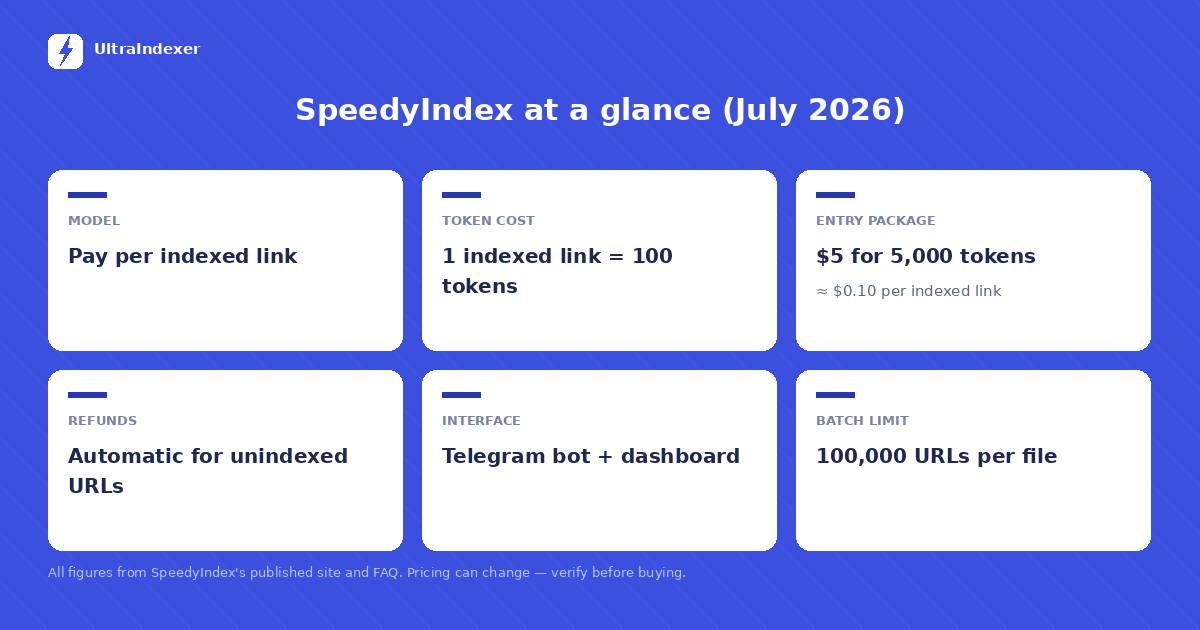
SpeedyIndex is a Google indexing service for backlinks and site pages. You submit a list of URLs. The service pushes them toward Google's crawler. You get a report showing which URLs were indexed. It runs on a 7-day task cycle: submit, wait, receive the final indexed or not-indexed report.
Two things stand out about how it operates. First, no Google Search Console is required. You can submit any URL, including backlinks on sites you do not own. Second, the primary interface is a Telegram bot, with a web dashboard alongside it. Files of up to 100,000 URLs can be submitted per task. There is no limit on how many tasks run at once. A drip-feed mode is available on the pay-per-result plan. It spreads delivery across a number of days you choose.
How the pay-per-result pricing works
SpeedyIndex prices in tokens. One successfully indexed link costs 100 tokens. Token packages start at $5 for 5,000 tokens. That covers roughly 50 indexed links, or about $0.10 per indexed link at entry level. The per-link cost drops as package sizes grow. Tokens never expire. There is no subscription and no monthly reset.
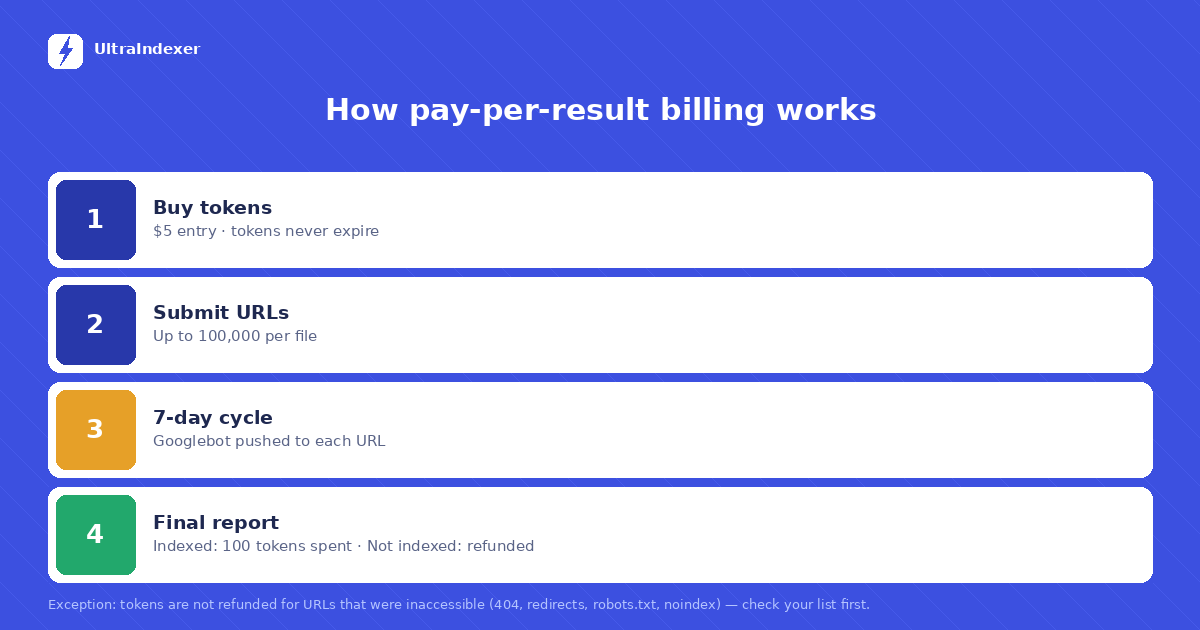
The refund mechanism is the heart of the model. When your 7-day task completes, tokens are deducted only for URLs confirmed as indexed. Tokens for unindexed URLs go back to your balance automatically. There is no claim to file and no support ticket. That aligns the service's incentive with yours in a way flat-fee submission services do not.
There is one important exception, documented in their own FAQ. Refunds apply when Google crawled the page but chose not to index it. They do not apply when the URL was inaccessible: a 404, a 403, a redirect loop, a robots.txt block, or a noindex tag. In those cases Google could not have indexed the page no matter the service. The tokens are still spent. The practical lesson: check your URLs for hard blockers before submitting a large task. Otherwise you pay for failures that were never SpeedyIndex's to fix.
What a task looks like, start to finish
Here is the flow a first-time user can expect. First, you buy a token package and load your balance. Next, you prepare a plain text file with one URL per line — up to 100,000 per file. You send the file to the bot or upload it in the dashboard and start the task. If you want the links fed out slowly, you turn on drip feed and pick the number of days.
Then you wait. The task runs its 7-day cycle while Googlebot is pushed toward each URL. On day 7 the final report lands. It lists each URL as indexed or not indexed. Tokens for the indexed ones are spent. Tokens for the rest come back to your balance on their own.
The whole loop is simple by design. The work that pays off is the step before it: making sure the list you feed in is clean, live, and free of blockers.
Speed and results: what their own data shows
SpeedyIndex publishes benchmark data rather than vague claims. That deserves credit, because it is rare in this niche. Their published testing says Googlebot reaches submitted pages in about 30 minutes on average. It also reports about half of submitted test pages indexed by day 28. Two caveats belong next to those numbers. They come from SpeedyIndex's own benchmark, not an independent audit. And the test used orphan pages — pages with no internal links pointing at them. That is close to a worst-case setup, so results on normal, linked pages should trend better.
The honest takeaway matches what SpeedyIndex itself says in its FAQ. No service can guarantee 100% indexation. The final decision is always Google's, and it depends on the quality of the page. A service can reliably get Googlebot to visit. It cannot force Google to keep what it finds. Any indexing tool that claims otherwise should be treated with suspicion — and so should any review of one.
What SpeedyIndex gets right
Incentive alignment. You pay only for what worked, and the rest comes back on its own. That is the fairest billing in this market. It shifted the whole niche when it arrived. It remains the model's biggest selling point.
Published data. Benchmarks with real numbers signal a service willing to be measured. That includes numbers as modest as a ~50% index rate on hard test pages. It is worth more than a wall of five-star testimonials.
No ownership requirement. A backlink indexer must handle URLs on sites you do not own. SpeedyIndex does this cleanly and at large volumes — up to 100,000 URLs per file.
Non-expiring tokens. Link building is bursty. A balance that waits for your next campaign fits how agencies actually work. It removes the quiet tax that subscriptions charge in slow months.
Where it falls short
Telegram-first workflow. The primary interface is a Telegram bot. It works, and power users automate around it. But teams that live in dashboards, and need client-ready exports, may find it awkward next to a web-first tool.
Entry-level cost per link. At the $5 starter package, roughly $0.10 per indexed link is on the pricey side for small users. The economics improve at larger packages. The model favors volume.
The refund exclusions put diagnosis on you. Inaccessible and noindexed URLs burn tokens without refund. So the model quietly assumes you already checked your list. Without a pre-check step, a messy backlink list gets expensive. Our guide to backlinks not getting indexed covers the blockers to rule out first.
A 7-day wait for the verdict. You learn your true results at the end of the window, not the same day. That is normal for how indexing actually works. Just plan reporting timelines around it.
Who SpeedyIndex is for — and who it is not
A good fit: link builders and affiliate SEOs who run campaigns in volume and want billing tied to outcomes. Agencies that draw down one token balance across many client tasks. Anyone happy to work through a Telegram bot or an API.
A weaker fit: beginners indexing a handful of links a month, where the entry per-link cost is hard to justify. Teams that need a polished web dashboard and client-ready exports as the default, not the add-on. And anyone whose pages fail to index for quality reasons. An indexer shows you that problem faster. It cannot fix it.
One more group should pause: people submitting lists they have never checked. The refund exclusions make unchecked lists the most expensive way to use the service. Check first, then submit.
How SpeedyIndex compares to the rest of the market
The indexing market has split into two camps. Subscription services charge a flat fee each month, no matter how much gets indexed. Our Indexification review covers the best-known one. Pay-per-result services like SpeedyIndex only charge when a link makes it in. For steady, very high volumes the flat fee can still win on price. For everyone else, paying for outcomes is simply the more honest structure, and it is where the market has moved.
Within the pay-per-result camp, tools differ on three things: how fast they are, how you use them, and what comes with the indexing — checking, diagnosis, and reporting. Our best backlink indexer roundup compares the field on those axes if you want the full picture before choosing.
SpeedyIndex vs UltraIndexer
Full disclosure again: UltraIndexer is our product. Here is the fair comparison.
The two services share a lot. Both verify results over a 7-day window. Both use credits that never expire instead of subscriptions. Neither requires Search Console. Where they differ is workflow. SpeedyIndex leads with Telegram, and checking is there on the side. UltraIndexer is a web-first dashboard built around the full loop. You bulk-check up to 5,000 URLs against Google's index, diagnose the failures, submit the fixable ones for indexing, and recheck. One place, per-URL reports at every step, and exports built for client reporting.
If your team runs on Telegram and wants indexing alone, SpeedyIndex is a credible choice. If your workflow is check-first — verify what is indexed before and after every campaign — the integrated approach is what we built for. Current rates for indexing and checking are on our pricing page.
How we compared
This review is based on SpeedyIndex's public website, FAQ, pricing pages, and their published indexing benchmark. All of it was reviewed in July 2026. We are not an affiliate of SpeedyIndex, and there are no affiliate links in this review. Claims about speed and index rates come from SpeedyIndex's own published data and are labelled as such. Pricing can change, so verify current rates on their site before buying. Where we compared them to our own product, we disclosed it in that section.
Frequently asked questions
Is SpeedyIndex legit?
Yes, it is an established service. The pay-per-result model is documented, the benchmark data is public, and refunds for unindexed URLs are automatic. As with any indexing service, results depend on the quality of the pages you submit.
How much does SpeedyIndex cost?
Token packages start at $5 for 5,000 tokens, and one indexed link costs 100 tokens — about $0.10 per indexed link at entry level, falling at larger packages. You are only charged for links confirmed as indexed; tokens for unindexed URLs are refunded automatically.
Does SpeedyIndex guarantee indexing?
No — and its own FAQ says no service can. SpeedyIndex promises that Googlebot will visit your URLs. Whether Google keeps a page comes down to the page itself, and the call is always Google's. Unindexed URLs get their tokens back, with exceptions for URLs that were inaccessible or blocked.
Do SpeedyIndex tokens expire?
No. Tokens are purchased once and remain on your balance until used. There is no subscription and no monthly reset.
Does SpeedyIndex work without Google Search Console?
Yes. No site verification is needed, which is what makes it usable for backlinks on third-party sites. You submit URL lists directly through the Telegram bot or dashboard.
What happens to links SpeedyIndex cannot index?
If Google crawled the page but chose not to index it, the tokens are automatically refunded when the 7-day task completes. If the URL was inaccessible — 404, 403, redirect loops, robots.txt blocks, or a noindex tag — tokens are not refunded, so check your list for those blockers before submitting.
Verdict: a fair model, honestly run
SpeedyIndex earns its reputation. The pay-per-result model is genuinely customer-aligned. The published data is honest about what indexing services can and cannot do. The token economics work well at volume. Its weak points are workflow ones: a Telegram-first interface, and a billing model that assumes you pre-checked your URLs for hard blockers.
That pre-check is where we would start, whichever indexer you choose. Run your list through a bulk index check first. Fix or drop the blocked URLs. Submit only what Google can actually index — whoever you submit it to. See UltraIndexer plans — pay as you go, credits never expire.